

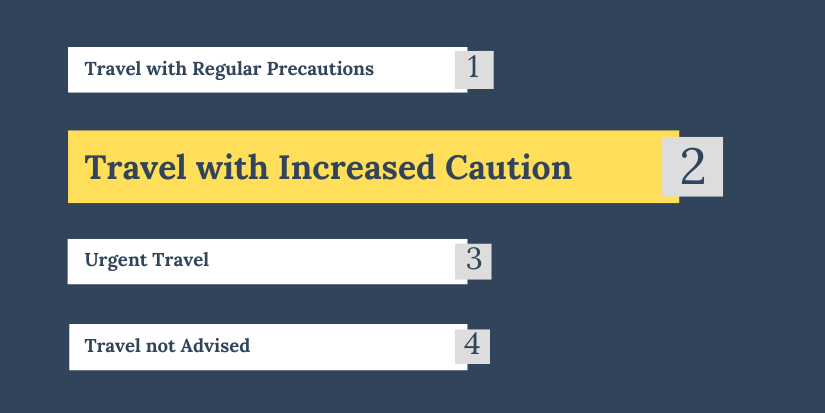
VISA REGIME
For holders of national passports and other travel documents: Visa required
For holders of diplomatic and official passports: No visas required for visits of up to 90 days
ENTERING AND LEAVING THE COUNTRY
The Republic of Equatorial Guinea can be reached by air or by land from neighboring countries. A visa must be obtained at the Embassy of the Republic of Equatorial Guinea in Rome, which covers the Republic of Serbia on a non-residential basis.
In addition to a visa, a yellow card (certificate of vaccination against yellow fever) is required for entry into Equatorial Guinea.
SOCIAL SECURITY AGREEMENT
There is no social security agreement concluded with Equatorial Guinea.
USEFUL INFORMATION
HEALTH SITUATION – Among tropical diseases, malaria is the most prevalent; therefore, the use of mosquito repellents (such as Autan Tropical, etc.) is recommended, as well as wearing clothing that covers the body (long pants, long-sleeved shirts). Yellow fever, dengue, Zika virus, and schistosomiasis (bilharzia) are also present in Equatorial Guinea.
It is recommended to have travel health insurance, as well as a certain amount of money to cover hospital expenses and medical evacuation if necessary. The capacity of local hospitals is very limited, except for La Paz Hospital.
As 6–7% of the population is infected with HIV (the highest percentage in Central Africa), it is recommended to take standard precautions to avoid exposure. Food is considered safe only in hotels or better-quality restaurants. Bottled water should always be used.
SECURITY SITUATION – The crime rate is moderate compared to other countries in the region, but caution is advised during your stay and when moving outdoors. There is a risk of robbery and attacks, and movement during evening hours, especially outside populated areas, is not recommended. Carrying large amounts of money or jewelry in the city should be avoided.
TRANSPORT – There is no organized public transport in Malabo or other cities, and the use of minibuses, vans, and motorcycle taxis used by the local population is not recommended. Business travelers and visitors are advised, where possible, to use a rented vehicle with a local driver.
The number of taxis is limited, but they may be used (it is recommended to order them through the hotel reception, agree on the fare in advance, and use only clearly marked taxis). During a tourist stay in Equatorial Guinea, you may drive a motor vehicle only with an international driving permit.
OTHER – The local currency is the Central African CFA franc (XAF). Withdrawing cash from ATMs is not always possible, while card payments are accepted in hotels, better restaurants, and shops. It is recommended to carry some cash in case card payments are not possible. Foreign currencies (most commonly EUR and USD) can be exchanged in banks or hotels (as this is a regional currency, the exchange rate is fixed).
Contact information:
During your stay in Equatorial Guinea, for consular assistance and protection you may contact the Embassy of the Republic of Serbia in Luanda, Angola, which covers Equatorial Guinea on a non-residential basis.
Phone numbers: +244 222 321 421, +244 222 327 240, +244 222 320 393, Mobile: +244 945 904 912; Email: srb.emb.angola@mfa.rs